

 简体中文(中国)

At Submarine Networks World (SNW) 2026 in Singapore (September 23–24, 2026), test and measurement specialist EXFO officially launched the USO-1618, positioned as the industry’s first and fastest co-propagation Optical Time-Domain Reflectometer (C-OTDR) engineered specifically for amplified submarine fiber-optic cables. By compressing fault localization to three minutes per fiber pair, the platform addresses one of the sharpest operational bottlenecks in subsea telecommunications: securing scarce marine repair vessel capacity before multi-day diagnostic delays compound outage losses.

3 Mins / Pair
Compresses full fault characterization on a 24-fiber-pair amplified cable from several days down to approximately 1 hour.
19 dBm • 20,000 km
Industry-highest 19 dBm launch power and 18 dB dynamic range penetrate cascaded subsea repeaters across transoceanic trunks.
~5-Meter Resolution
Pinpoints exact seabed break coordinates to reduce grapple passes, shorten ship time at sea, and limit excess spare-cable splicing.
1. The SNW 2026 Launch & Operational Context
Unveiled at Booth H11 during Submarine Networks World 2026 alongside technical presentations on hyperscale subsea testing in the AI era, the EXFO USO-1618 targets the widening gap between submarine cable fault frequency and global marine repair capacity:
- Severe Repair Vessel Scarcity: Globally, roughly 200 submarine cable faults occur every year, all competing for a global fleet of only about 25 dedicated cable-repair vessels.
- High Downtime & Operational Impact: Operators wait an average of 90 days between initial fault detection and the start of offshore repair operations, incurring substantial capacity-rerouting expenses and SLA exposure alongside marine vessel running costs.
- The High-Fiber-Count (SDM) Testing Bottleneck: Modern Space-Division Multiplexing (SDM) cables built for cloud and AI backbone traffic routinely deploy 16 to 24+ fiber pairs, compared with 4 to 8 pairs on legacy systems. Because conventional submarine OTDRs take one to several hours per fiber pair, full diagnostics across a 24-pair system can consume several days—delaying marine permitting and pushing the operator to the back of the repair-ship queue.
- Winning the “First-in-Queue” Advantage: By cutting per-pair measurement time to 3 minutes (approx. 1 hour for a full 24-pair cable), the USO-1618 enables operators to deliver verified fault coordinates to repair ship dispatchers first.
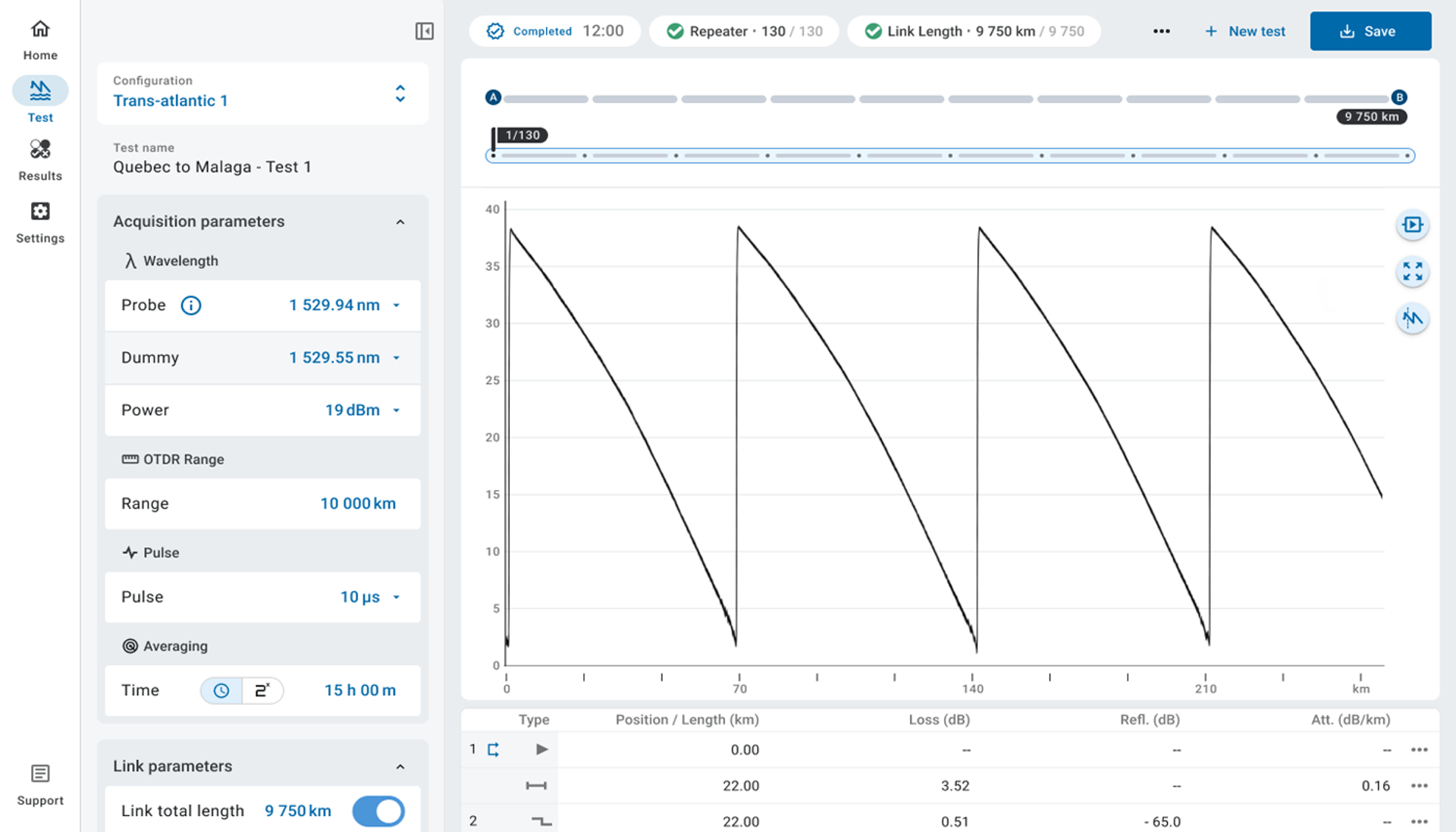
2. Why C-OTDR Is Required & USO-1618 Key Specifications
Standard terrestrial OTDRs cannot operate across transoceanic submarine cables because inline Erbium-Doped Fiber Amplifiers (EDFAs) inside seabed repeaters contain optical isolators that enforce strictly unidirectional light transmission, blocking standard backward-traveling Rayleigh backscatter.
A C-OTDR overcomes this barrier by injecting high-power test pulses in the forward direction (co-propagating with live traffic) through the chain of subsea amplifiers. At each repeater (spaced roughly 50 to 80 km apart), a high-loss passive loopback coupler routes a small fraction of the forward-traveling backscattered light onto the opposing return fiber pair, allowing it to travel back to the landing station receiver.
| Parameter / Feature | EXFO USO-1618 Specification | Operational Benefit |
|---|---|---|
| Measurement Speed | ~3 minutes per fiber pair (per 1,000 km preliminary) | Reduces full validation of a 24-fiber-pair amplified cable from days to ~1 hour. |
| Optical Output Power | 19 dBm (industry-highest) | Delivers higher signal-to-noise ratio (SNR) into the first amplifier for faster, cleaner traces. |
| Dynamic Range | Up to 18 dB across amplified topologies | Penetrates high-loss repeater loopback paths across hundreds of cascaded EDFAs. |
| Maximum Reach | Up to 20,000 km | Covers ultra-long-haul transpacific and transoceanic repeatered trunks in a single test. |
| Spatial Resolution | ~5 meters | inpoints exact fault locations on the seabed, reducing grapple passes, ship days at sea, and excess spare-cable splicing. |
| Wavelength Tuning | C-band tunable (1527.99 nm – 1567.95 nm) | Supports in-service testing on unused DWDM channels without disrupting active traffic. |
| Form Factor & OS | Dual-use 2U rackmount & portable (Linux-based) | Saves rack space in Cable Landing Stations (dry plant) while remaining portable for repair vessels (wet plant). |
| Automation & APIs | Icon-based link view, JSON I/O & REST API | Eliminates manual trace interpretation, enforces pre-approved test templates, and integrates into Cable Management Systems. |
3. Q&A Analysis: Key Industry Questions & Operational Concerns
While the USO-1618 introduces major speed and workflow improvements, submarine network engineers frequently raise practical questions regarding EXFO’s “industry’s first” claim, its overlap with vendor-embedded monitoring, and multi-pair automation:
It is a terminology rebranding paired with a generational hardware upgrade. For more than two decades, subsea operators have relied on instruments called C-OTDRs—such as the legacy Anritsu MW90010A/B and Yokogawa AQ7750—where the “C” stood for Coherent OTDR (named after the heterodyne coherent detection physics used to extract weak loopback backscatter).
EXFO retained the familiar C-OTDR acronym so submarine operators immediately recognize its function, but redefined the “C” as Co-propagation OTDR (named after the forward signal-routing topology through unidirectional EDFAs). While the underlying repeater-loopback physics is well established, EXFO’s hardware upgrades—19 dBm output power, faster DSP trace averaging, full C-band tunability, and a Linux/REST API software stack—represent a substantial generational leap over 15- to 25-year-old legacy Coherent OTDR platforms.
Embedded vendor monitoring and standalone C-OTDRs serve two complementary stages of submarine fault management:
- Open-Cable Disaggregation: Modern subsea networks decouple wet-plant suppliers (SubCom, ASN, NEC) from dry-plant SLTE vendors (Ciena, Nokia), with different consortium partners or hyperscalers lighting individual fiber pairs. A standalone, API-driven C-OTDR provides a vendor-neutral diagnostic layer across multi-vendor fiber pairs.
- Span-Level vs. Meter-Level Precision: Embedded Line Monitoring Equipment (LME) relies primarily on repeater telemetry (pump laser currents and supervisory tones), which narrows a fault down to a 50–80 km repeater span. Dispatching a repair ship requires ~5-meter physical localization—especially when power feed equipment is shut down—which requires high-power C-OTDR injection.
- Offshore Repair Vessel & Commissioning Work: Shore-based LME stays inside the Cable Landing Station. Once a repair ship recovers a cable from the seabed, splices in spare segments, and prepares to lower the final bight back to the seafloor, marine engineers aboard the vessel require a portable C-OTDR to validate splice integrity before leaving the site.
Not natively on its own, but it supports fully automated multi-pair sweeps when paired with an external optical switch. Out of the box, the USO-1618 connects to one fiber pair at a time (transmit and receive ports).
Inside a Cable Landing Station, operators can pair the 2U rackmount USO-1618 with an external multi-port MEMS optical switch—such as EXFO’s FTBx-9110 or OTH-7000 / RTUe-9120 remote fiber monitoring units. Using the USO-1618’s native REST API and JSON in / JSON out architecture, an operator’s Cable Management System can automatically step the optical switch from Pair 1 through Pair 24, trigger pre-configured JSON test profiles, and ingest structured fault reports hands-free. Keeping switching external avoids adding insertion loss to the 19 dBm output budget and keeps the portable unit lightweight for offshore ship deployment.
Yes. Because the USO-1618 is C-band tunable across 1527.99 nm to 1567.95 nm, engineers can tune the test laser to an unoccupied guard band or unused DWDM channel and couple the signal into the live fiber pair without interfering with active traffic wavelengths. This allows operators to verify link integrity during live capacity upgrades or diagnose gradual shunt degradation before a catastrophic break occurs.
Subsea cable cuts are high-stakes, infrequent emergencies at individual landing stations, and local on-call staff may lack deep expertise in interpreting noisy Rayleigh backscatter traces. The USO-1618 addresses this through two workflow safeguards:
- Supervisor-Locked Test Templates: Senior subsea engineers pre-define and lock approved wavelength, pulse-width, and threshold configurations in advance, so local technicians only need to load and execute the profile.
- Automated Icon-Based Link View: Rather than forcing staff to manually measure cursor distances on raw waveforms, the software automatically detects breaks or anomalous loss events and displays an intuitive icon map with exact fault coordinates—reducing the risk of sending a repair vessel to imprecise coordinates and prolonging outage restoration.
By combining 19 dBm optical launch power, 3-minute per-pair acquisition, and API-driven automation in a dual-purpose 2U rackmount and portable chassis, the EXFO USO-1618 modernizes C-OTDR testing across the entire subsea cable lifecycle—from factory and marine commissioning to landing-station fault isolation and offshore repair validation.
