

 简体中文(中国)

In a landmark demonstration of long-distance seismic sensing, Alcatel Submarine Networks (ASN) has successfully detected an earthquake occurred in Japan on April 20, 2026, using its SMART Climate Change (CC) solution—operating not from a nearby station, but from the company's headquarters in Les Ulis, France, over 9000 kilometers away from the earthquake origin.
The demonstration represents a major validation of distributed acoustic sensing (DAS) technology for earthquake monitoring and early warning applications. The ability to detect seismic activity on the opposite side of the planet using existing or newly deployed subsea cable infrastructure underscores the strategic value of SMART (Scientific Monitoring and Reliable Telecommunications) cable systems for global disaster preparedness.
The Japanese Earthquake Detection Event
At 7:53 AM UTC, a magnitude 7.4 earthquake shook the north-eastern coast of Japan.
According to ASN, around 15 minutes later, the first seismic wave (P Wave) reached the Paris area and after 35 to 40 minutes the strongest surface waves, after traveling 9380 km. Traces of the waves were perfectly visible on the screens of the test team in Les Ulis, reported from the embedded CC Node seismometer through the different components of the SMART CC Solution. After analysis, including the realignment of Z, North and East axis thanks to the orientation data reported by the North Finder embedded in the node, these traces showed a very strong similarity with the measurement from the Paris-Jussieu reference seismic station.
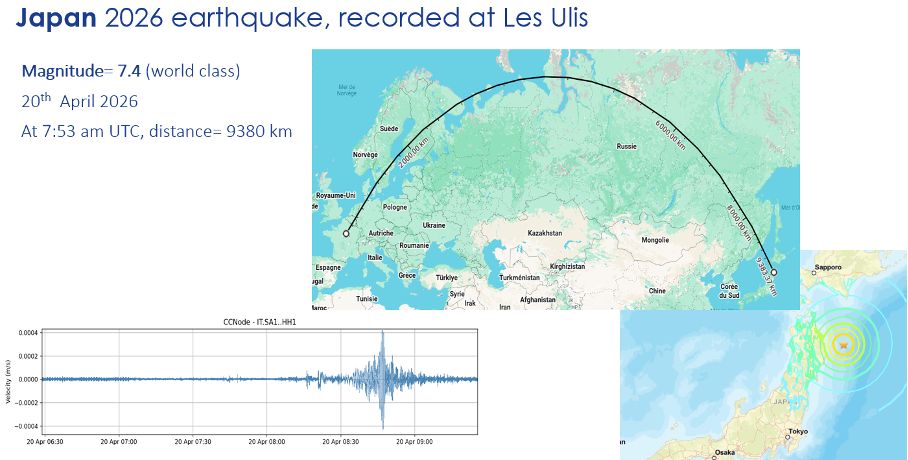
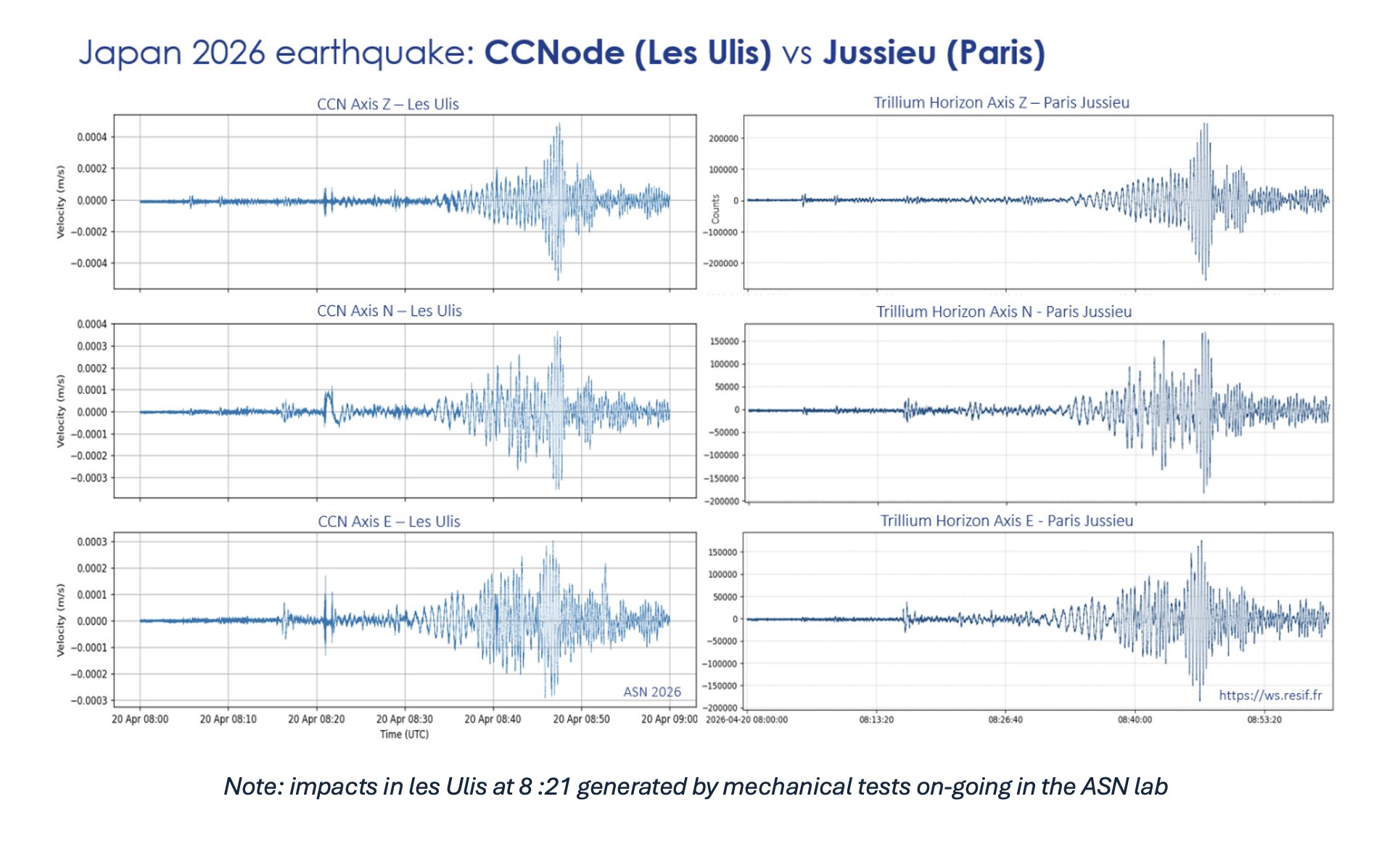
The capture of seismic activity originating from Japan using equipment located in the Paris suburbs demonstrates the sensitivity and reach of ASN's CC solution. While ASN has not publicly released the specific magnitude or timing of the detected event, the successful long-distance detection validates the core premise of SMART cables: that telecommunications infrastructure can be repurposed as a global scientific monitoring network without compromising its primary function.
This capability has direct applications for tsunami early warning. By detecting the seafloor ground motions that generate tsunamis, the system can provide precious additional minutes for coastal evacuations.
How It Works: ASN's OptoDAS Technology
ASN's Climate Change solution integrates multiple sensing technologies into subsea telecommunications infrastructure. At its core is the OptoDAS (Distributed Acoustic Sensing) product, which transforms standard undersea fiber optic cables into a continuous array of seismic sensors.
Unlike conventional seismometers that require dedicated installations at specific points, ASN's OptoDAS technology utilizes the fiber itself as the sensing medium. Light pulses are transmitted through the fiber, and by analyzing the backscatter from minute disturbances along the cable, the system can detect vibrations, acoustic signals, and strain changes over thousands of kilometers.
This approach offers several advantages:
- Cost Efficiency: Leverages existing or planned telecom cables, eliminating the need for dedicated seafloor observatories
- Coverage: Provides continuous monitoring across the entire cable length, not just at discrete points
- Real-time Data: Enables immediate detection and characterization of seismic events
Technical Collaboration and Sensor Integration
ASN has partnered with leading instrumentation specialists to develop its SMART Cable solution. The company announced a strategic collaboration with Nanometrics (NMX) and RBR in September 2024.
| Partner | Specialty | Role in SMART Solution |
|---|---|---|
| Nanometrics | Global leader in seismic instrumentation (>50% of broadband seismic market) | Custom ocean-bottom seismic sensors |
| RBR | Precision environmental monitoring | Temperature and pressure sensors for climate/tsunami detection |
This collaboration combines ASN's deep expertise in subsea transmission (over 800,000 km of optical cables installed globally) with specialized sensing capabilities .
ASN President and CEO Alain Biston stated at the time: "Our efforts to develop the SMART technology is another testimony of ASN's commitment to sustainability in the implementation of subsea optical networks. We believe that Nanometrics and RBR are the right partners for developing this complete SMART solution"
Current SMART Cable Deployment Projects
ASN is actively deploying its SMART technology in two pioneering projects scheduled for completion in 2026.
Anel CAM (Portugal, Madeira, Azores)
This Anel CAM system will connect mainland Portugal to the archipelagos of Madeira and the Azores. The region is seismically active, and the SMART cable will enhance earthquake and tsunami monitoring for the islands and the surrounding North Atlantic.
Tamtam (New Caledonia – Vanuatu)
The Tamtam cable is toasted to be the world's first dedicated SMART cable project.
- Length: Approximately 450 km
- Route: Connects Lifou (New Caledonia) to Port Vila (Vanuatu)
- SMART Nodes: Integrated with four advanced Climate Change Nodes (CC Nodes) equipped with seismic, pressure, and temperature sensors
- Strategic Importance: Spans the seismically volatile New Hebrides Trench
- Data Access: Scientific and civil protection authorities will have license-free access to real-time data
The New Hebrides Trench is a major subduction zone where the Australian Plate subducts beneath the Pacific Plate, generating significant seismic and tsunami risk for the 650,000 inhabitants of the region.
Industry and Strategic Implications
The demonstration confirms that SMART cable technology is operationally viable for:
- Tsunami Early Warning: Real-time detection of undersea earthquakes enables faster, more accurate tsunami alerts
- Climate Change Monitoring: Pressure and temperature sensors track ocean heat content and sea-level rise
- Volcanic Activity Monitoring: Early detection of seafloor volcanic activity
- Infrastructure Protection: Asset integrity monitoring for subsea power and telecom cables
The technology could encourage telecom cable owners to include SMART capabilities in future systems. The incremental cost of adding sensors is modest compared to the overall cable investment, while the societal value—in terms of lives saved and infrastructure protected—is substantial.
ASN's demonstration reinforces France's position as a global leader in subsea cable technology and ocean science. France is actively supporting SMART cable deployments through its overseas territories (New Caledonia, French Polynesia) and its funding partnerships (French Government support for the Tamtam project).
ASN's Climate Change solution represents a convergence of two strategic priorities: global connectivity and planetary resilience. The successful detection of seismic activity across the Pacific from France is both a technical milestone and a proof of concept that the world's submarine cable network can be transformed into the largest and most cost-effective sensor array ever deployed.
As the Ancel CAM and Tamtam cables approach their 2026 ready-for-service dates, the industry will be watching closely to validate these technologies in their designated operational environments.
The final piece will be establishing the data-sharing frameworks and funding models necessary to ensure that early warning data reaches vulnerable populations in time to act. The technology, as the Les Ulis demonstration shows, is already here.
